The SAO Framework: The Order Behind a Sound Technology Decision
Many technology decisions begin with a vendor’s pitch. The SAO Framework begins with a thorough understanding of the need.
Off to the wrong start
A procurement decision usually starts when someone in the business needs something. A contract is coming up for renewal. A site needs more capacity. A platform gets a demo that looks good. Each of those moments opens a conversation with a seller, and each seller has a product that fits the question as they have framed it. That framing happens before anyone has documented what is in place today, what it costs, or where the exposure sits. Many costly technology decisions start there.
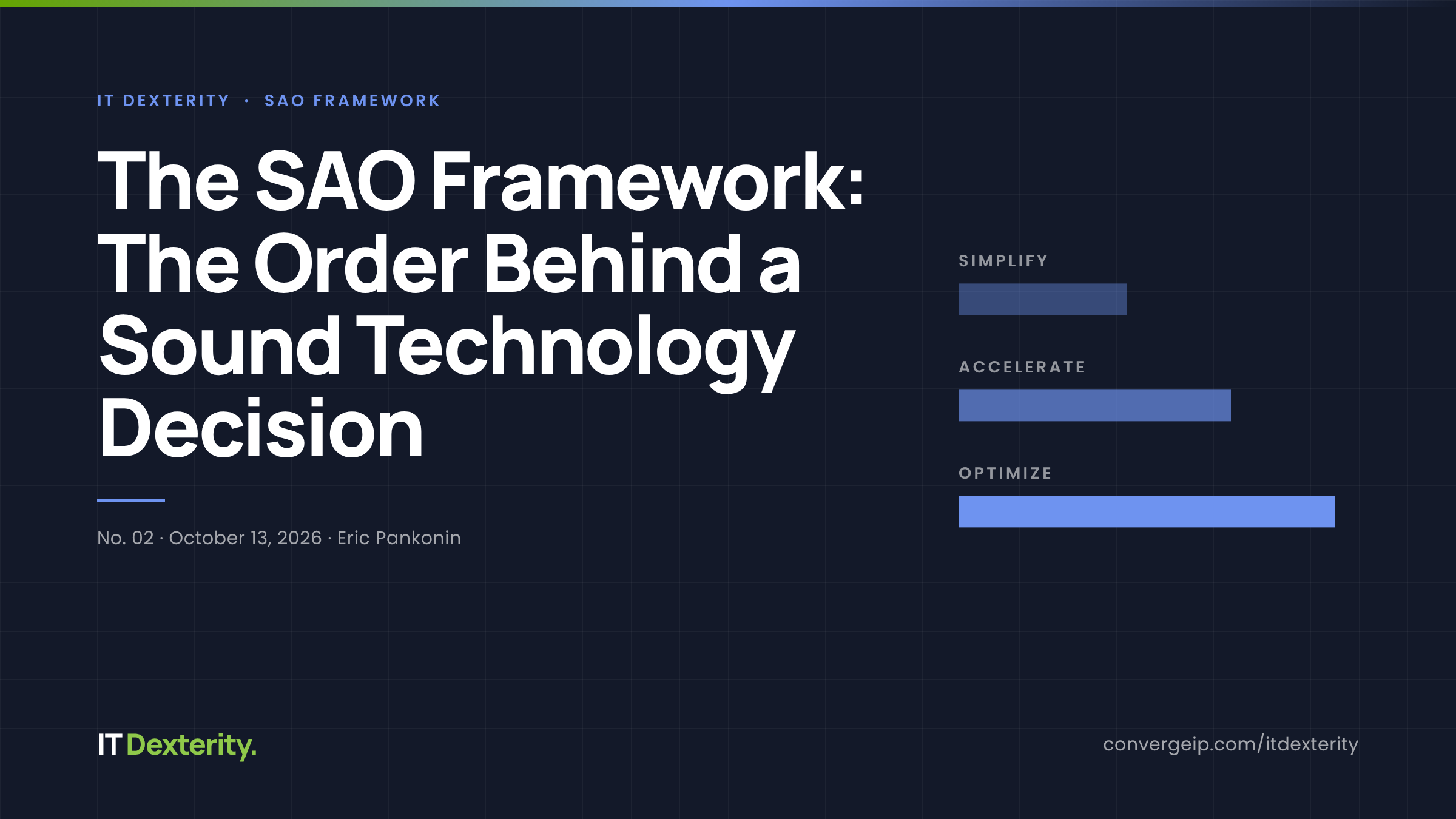
The SAO Framework reverses the order. It moves a decision through three phases: Simplify, Accelerate, and Optimize. Each phase has a purpose, a set of outputs, and a decision gate at the end. The next phase does not start until the gate is passed.
Simplify: clarify the present
Simplify starts with a Strategic Fit Call to learn your situation and the pain points that brought you to it. If there is a fit, the work builds a clean baseline through stakeholder interviews, structured service contract audit, and general benchmark analysis of the technology(ies) affected. The output is a clear view of cost exposure, performance gaps, renewal risk, and modernization priorities. That view is documented and belongs to you, whatever you decide next. The engagement is called the Service Optimization Review™. No vendor outreach happens in this phase.
Accelerate: structure the decision
With the baseline in place, Accelerate turns clarity into a decision. The work further defines requirements, maps the vendor landscape for the best fits, engages with those vendors for proposals, normalizes the quotes so they can be compared, models the financials, and leads the negotiation. Vendors are engaged only inside that structure, on terms the client has set. This is the Strategic Market Engagement™.
Optimize: protect the outcome
Selection is where the work changes shape and a decision is made. Optimize carries it through implementation governance, SLA monitoring, billing audit, and renewal oversight, so the investment keeps delivering after the signature. This is Outcome Stewardship™.
Six gates
Each numbered phase in the lifecycle closes on a named decision. A gate is a point where either side can stop, and that is the reason to have them.
Initial Conversation: whether there is a real opportunity to make desired changes with the current internal and market conditions.
Executive Alignment: whether to proceed with the Service Optimization Review or park the project.
Decision Authorization: whether the assessment is complete and the organization is ready to develop a solution.
Agreement Authorization: whether a solution is selected and the agreement is executed.
Successful Implementation: whether the solution is live and handed to operations.
Renewal Review: whether to renew or expand, or restart the cycle at the beginning.
A gate forces the decision to happen with the facts in front of it. Without gates, work tends to move forward on momentum, and the decision gets made by default. A renewal review that finds the market has moved can restart the cycle with better information than the last time.
The steps inside the phases
Four steps carry the work through the three phases. Inspect establishes clarity through discovery, contract visibility, and operational baseline mapping, and it informs Simplify. Select structures the market engagement and aligns decisions to measurable outcomes, and it structures Accelerate. Connect oversees implementation and protects service integrity, and it initiates Optimize. Protect maintains performance visibility and renewal discipline, and it sustains Optimize. Later issues will take each step in turn either resulting in a renewal or a search for a new solution where the process begins anew.
What to do before your next vendor conversation
Write down three things: what you have today and what it costs, which contracts renew in the next 12-24 months, and who owns each decision. That list is the material for the first gate.
If you want the Simplify step run against your environment, book a Strategic Fit Call: https://www.convergeip.com/schedule
Get the next issue in your inbox.
Vendor-agnostic analysis for IT leaders in banking, healthcare, and government. One piece a week. No vendor pitches.
Eric Pankonin · Founder, Converge IP · 30+ years in enterprise IT and telecom